Stakeholder Analysis Matrix: Prioritising Engagement for Climate Action

Author/s:

Benefits of the Practice

Helps focus engagement efforts on the most important and influential stakeholders
Improves resource allocation by identifying which groups need more attention
Supports risk management by making it easier to anticipate stakeholder reactions and plan accordingly
English language

Summary for Practitioners on the Main Finding/s or Innovative Solution/s

Engaging key actors within the national Climate‑Smart Agricultural Knowledge and Innovation System (CS‑AKIS), such as farmers, advisors, researchers, policy makers, technology providers, and the general public, is vital for effective climate‑smart advising and farming. The CSA project developed a 6‑step approach for National Coordinators and Climate Smart Coaches to activate and engage CS‑AKIS actors.

To ensure effective engagement, these actors need to be categorised and prioritised according to their relevance for climate‑smart advising and farming. Stakeholder engagement is resource‑intensive, and not all actors have the same level of interest in or influence on climate action. The Stakeholder Analysis Matrix (Mendelow’s matrix) is a practical tool to support this process.

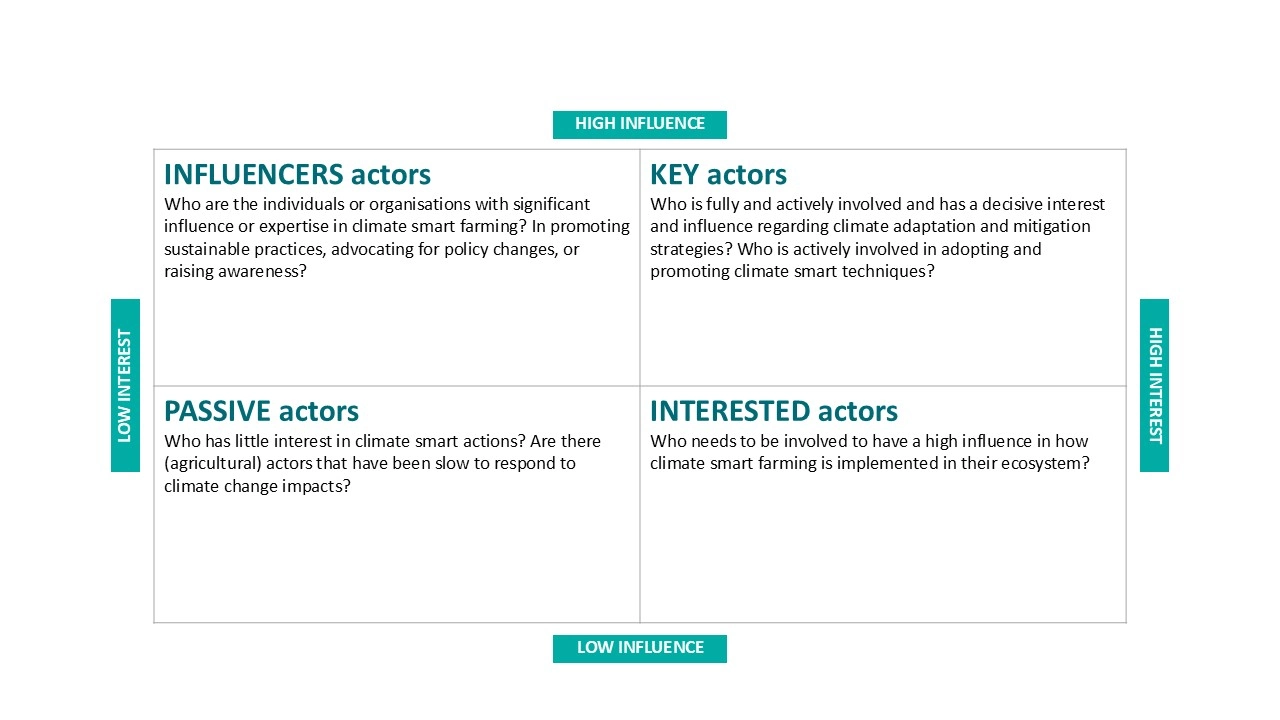
This matrix helps assess and plot CS‑AKIS actors-identified through the Network Analysis (Practice Abstract 61)-according to two key criteria: interest and influence. In the context of climate‑smart advising, interest refers to an actor’s motivation to engage with climate action (e.g. mitigation, adaptation, or resilience), while influence refers to their ability to shape decisions, policies, investments, or advisory priorities related to climate‑smart farming.

By mapping actors on the matrix, four priority groups emerge:
1. Key stakeholders: high interest, high influence – these require close engagement and partnership.
2. Influencers: high influence, low interest – these should be kept satisfied and informed.
3. Interested stakeholders: high interest, low influence – these should be kept informed and involved where possible.
4. Passive stakeholders: low interest, low influence – these require minimal but respectful communication.

This exercise makes visible who the most important and influential actors are and highlights those who are important but not yet engaged. It also supports risk management by anticipating potential reactions and identifying opportunities for collaboration.

Native language

Het betrekken van sleutelactoren binnen het nationale Climate‑Smart Agricultural Knowledge and Innovation System (CS‑AKIS), zoals landbouwers, adviseurs, onderzoekers, beleidsmakers, technologieaanbieders en het brede publiek, is essentieel voor effectieve klimaatslimme advisering en landbouw. Het CSA‑project ontwikkelde daarom een 6‑stappenaanpak voor Nationale Coördinatoren en Climate Smart Coaches om CS‑AKIS‑actoren te activeren en te betrekken.

Om de betrokkenheid doeltreffend te organiseren, is het nodig deze actoren te categoriseren en te prioriteren op basis van hun relevantie voor klimaatslimme advisering en landbouw. Stakeholderbetrokkenheid is resource‑intensief en niet alle actoren hebben dezelfde mate van interesse in of invloed op klimaatactie. De Stakeholderanalyse‑matrix (matrix van Mendelow) is een praktisch hulpmiddel om dit proces te ondersteunen.

De matrix helpt om CS‑AKIS‑actoren – geïdentificeerd via de Netwerkanalyse (Practice Abstract 61) – te positioneren op basis van twee criteria: interesse en invloed. In de context van klimaatslimme advisering verwijst interesse naar de motivatie om zich in te zetten voor klimaatactie (bv. mitigatie, adaptatie of weerbaarheid), terwijl invloed slaat op het vermogen om beslissingen, beleid, investeringen of adviesprioriteiten met betrekking tot klimaatslimme landbouw te sturen.

Op basis hiervan worden vier prioritaire groepen onderscheiden:
1. Sleutelactoren: hoge interesse, hoge invloed — nauwe betrokkenheid en partnerschap.
2. Influencers: hoge invloed, lage interesse —tevreden en geïnformeerd houden.
3. Geïnteresseerde actoren: hoge interesse, lage invloed — informeren en waar mogelijk betrekken.
4. Passieve actoren: lage interesse, lage invloed —minimale maar respectvolle communicatie.

Deze oefening maakt zichtbaar welke actoren cruciaal zijn, welke nog onvoldoende betrokken zijn en ondersteunt risicobeheer en samenwerking.