
This Practice Abstract was developed within the Spanish Community of Practice “Culture” of the ClimateSmartAdvisors project, based on knowledge exchange and the compilation of good practices to help farmers and advisors adopt climate-smart and sustainable crop protection strategies. Biological control is a key tool for sustainable pest management in horticultural greenhouses, but its effectiveness depends on proper planning and its application as an integrated system. The main challenge is to ensure stable and effective biological control against pests such as thrips, whiteflies, aphids, or tomato leaf miners, while reducing dependence on chemical plant protection products.
Results show that successful biological control does not rely only on releasing commercially available natural enemies, but on early pest identification, preventive introduction of beneficial
organisms adapted to the crop and season, proper greenhouse climate management, and integrated crop management. In regions such as Almería, this approach has enabled adoption in around 82% of greenhouses.
In practice, biological control should be implemented preventively, avoiding incompatible chemical treatments, ensuring continuous crop monitoring, and promoting biodiversity through the combination of commercial and naturally occurring beneficial organisms, supported by refuge plants.
Practical experiences confirm its effectiveness. The use of bumblebee hives in tomato crops has improved fruit quality and facilitated the transition to pesticide-compatible strategies. Biological control of leaf miners with parasitoids (e.g. Diglyphus isaea) has enabled long-term pest suppression with minimal interventions. In sweet pepper, the use of predatory mites and bugs against thrips has helped overcome resistance issues and reduce residues.
Although an initial investment is required, benefits include greater production stability, reduced chemical residues, improved working conditions, and better market acceptance.
Este Resumen Práctico se desarrolló en la Comunidad de Práctica española “Cultura” del proyecto ClimateSmartAdvisors, basado en el intercambio de conocimientos y la recopilación de buenas prácticas para ayudar a agricultores y asesores a adoptar estrategias de protección de cultivos sostenibles y climáticamente inteligentes. El control biológico es una herramienta clave para la gestión sostenible de plagas en invernaderos hortícolas, pero su eficacia depende de una adecuada planificación y aplicación como un sistema integrado. El principal reto es garantizar un control biológico estable y eficaz frente a plagas como trips, mosca blanca, pulgones o minadores de hoja del tomate, reduciendo la dependencia de productos fitosanitarios.
Los resultados muestran que el éxito del control biológico no depende solo de liberar enemigos naturales comerciales, sino de la identificación temprana de plagas, introducción preventiva de organismos beneficiosos adaptados al cultivo y temporada, gestión adecuada del clima del invernadero y manejo integrado del cultivo. En regiones como Almería, este enfoque se ha adoptado en alrededor del 82 % de los invernaderos.
En la práctica, el control biológico debe implementarse de forma preventiva, evitando tratamientos químicos incompatibles, asegurando un monitoreo continuo del cultivo y fomentando la biodiversidad mediante la combinación de organismos beneficiosos comerciales y naturales, apoyándose en plantas refugio.
Las experiencias prácticas confirman su eficacia. El uso de colmenas de abejorros en cultivos de tomate ha mejorado la calidad del fruto y ha facilitado la transición hacia estrategias compatibles con pesticidas. El control biológico de minadores de hoja con parasitoides (por ejemplo, Diglyphus isaea) ha permitido la supresión de la plaga a largo plazo con intervenciones mínimas. En pimiento dulce, el uso de ácaros y chinches depredadores contra trips ha ayudado a superar problemas de resistencia y reducir residuos.
Aunque requiere una inversión inicial, los beneficios incluyen mayor estabilidad del sistema productivo, reducción de residuos químicos, mejora del entorno laboral y mejor aceptación en el mercado.
The implementation of biological control is facilitated by access to specialized technical advice, farmer training, and on-farm demonstrations, many of which were promoted through the Spanish Community of Practice (CoP) “Culture” of the ClimateSmartAdvisors project. Peer-to-peer learning and knowledge exchange among farmers and advisors are also key to building confidence and improving decision-making.
A major challenge is the transition from chemical control, as incompatible products or residual effects from previous cropping cycles can hinder the establishment of beneficial organisms. This transition often requires changes in management practices, increased monitoring, and a shift towards preventive approaches.
Successful adoption depends on a gradual transition strategy, combining early pest detection, preventive releases of beneficial organisms, and biodiversity-based measures. Collaboration among farmers, advisors, suppliers, and research centers plays a crucial role in ensuring technical support, adapting solutions to local conditions, and scaling up implementation.
Future actions should focus on strengthening advisory services, expanding farmer training programs, and improving access to knowledge and practical tools. Supporting the wider adoption of integrated, climate-smart pest management systems will be essential to enhance resilience, reduce chemical inputs, and meet market and regulatory demands.
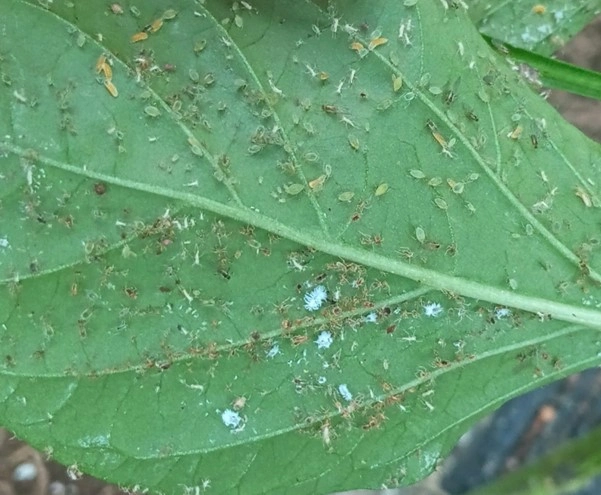
Experiencias de control biológico por conservación en horticultura protegida.
Control biológico: herramienta clave en el control del ‘Thrips parvispinus’.