Implementing Transitions in Climate Smart Farming-the Role of Resources and Capabilities

Benefits of the Practice

Increased adaptive capacity
Better resource mobilisation
More targeted strategies
English language

Summary for Practitioners on the Main Finding/s or Innovative Solution/s

Accelerating the transition to Climate-Smart Farming (CSF) requires more than promoting new practices or technologies. Advisors need to work across multiple levels: with individual farmers and farm businesses, with groups and networks, and with enterprises, policymakers and institutions shaping the wider agricultural and AKIS environment. Through these interactions, they also help reshape how CSF and advisory work are understood and applied.

Supporting climate-smart transitions requires more than individual technologies or isolated practices. A useful way to understand and strengthen innovation is through the combination of Resources, Capabilities, Innovations and Collaborations (RCCIs). Resources include tangible and intangible assets such as funding, infrastructure, data, knowledge, skills and networks. Capabilities are the individual, organisational and technological abilities needed to mobilise these resources and adapt them to local conditions. Resources and capabilities are interdependent: resources enable action, while capabilities determine how they are combined and used. Innovations and collaborations can function as both, reflecting the dynamic nature of transition processes.

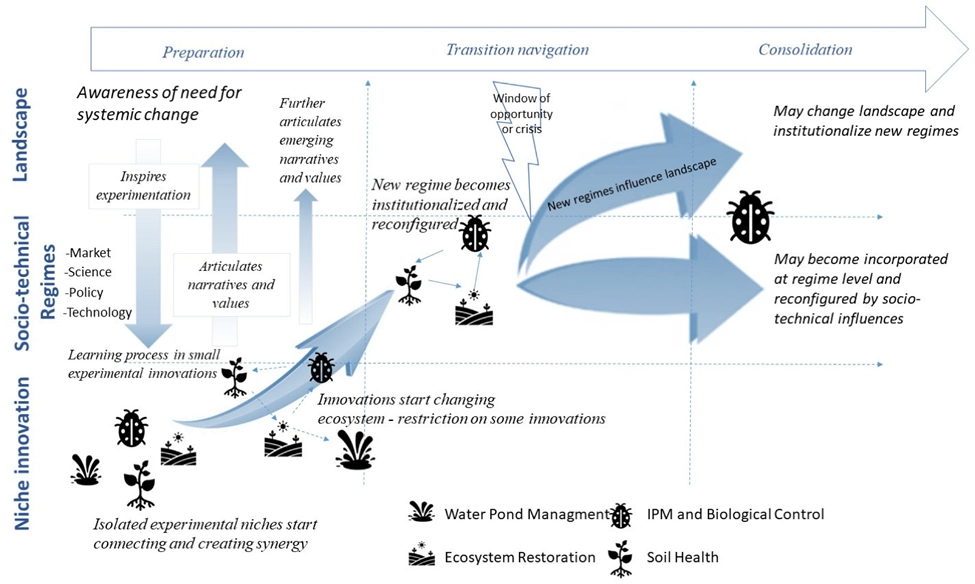
Capabilities within these processes are not static. In uncertain contexts, dynamic capabilities are key because they enable actors to learn, adapt and reconfigure resources and skills. Research on sustainability-oriented innovation shows they support experimentation, coordination and scaling, helping initiatives move from local testing towards system-level impact. These capabilities develop over time and across levels, from on-farm experimentation to collective learning and engagement with institutional contexts

Native language

Acelerar la transición hacia la agricultura climáticamente inteligente (CSF) requiere algo más que promover nuevas prácticas o tecnologías. Los asesores deben trabajar en múltiples niveles: con agricultores individuales y explotaciones agrícolas, con grupos y redes, y con empresas, responsables políticos e instituciones que configuran el entorno agrícola y de los sistemas de información agrícola (AKIS) en general. A través de estas interacciones, también contribuyen a redefinir la forma en que se entienden y aplican la CSF y la labor de asesoramiento.

Apoyar las transiciones climáticamente inteligentes requiere algo más que tecnologías individuales o prácticas aisladas. Una forma útil de comprender y fortalecer la innovación es mediante la combinación de recursos, capacidades, innovaciones y colaboraciones (RCCI). Los recursos incluyen activos tangibles e intangibles, como financiación, infraestructura, datos, conocimientos, habilidades y redes. Las capacidades son las habilidades individuales, organizativas y tecnológicas necesarias para movilizar estos recursos y adaptarlos a las condiciones locales. Los recursos y las capacidades son interdependientes: los recursos permiten la acción, mientras que las capacidades determinan cómo se combinan y utilizan. Las innovaciones y las colaboraciones pueden funcionar como ambos, lo que refleja la naturaleza dinámica de los procesos de transición.

Las capacidades dentro de estos procesos no son estáticas. En contextos de incertidumbre, las capacidades dinámicas son fundamentales, ya que permiten a los actores aprender, adaptarse y reconfigurar recursos y habilidades. Las investigaciones sobre la innovación orientada a la sostenibilidad demuestran que estas capacidades favorecen la experimentación, la coordinación y la ampliación, lo que ayuda a que las iniciativas pasen de la fase de pruebas locales a generar un impacto a nivel sistémico. Estas capacidades se desarrollan con el tiempo y en distintos niveles, desde la experimentación en las explotaciones agrícolas hasta el aprendizaje colectivo y la interacción con los contextos institucionales.

Additional Information

Analysing RCCIs has analytical and strategic value. Analytically, the framework explains how climate-smart transitions unfold as evolving combinations of assets, skills, innovation activities and collaboration patterns. Strategically, it offers advisors and other AKIS actors a practical lens to identify gaps, strengthen adaptive capacity and design targeted interventions that sustain transitions over time.

Microfoundations of dynamic capabilities enabling scaling pathways of sustainability‐oriented innovation business models. From Mehrabi, S., Mahdad, M., Bijman, J., Cholez, C., Mesa, J. C. P., & Giagnocavo, C. (2025). Microfoundations of dynamic capabilities enabling scaling pathways of sustainability-oriented innovation business models. Business Strategy and the Environment, 34(1), 849–871. https://doi.org/10.1002/bse.4004