Spotting Barriers and Enablers for Climate-Smart Advice with PESTLE

Author/s:

Benefits of the Practice

Identifies policy, financial, and knowledge barriers for climate-smart advice
Highlights concrete opportunities to integrate climate action in AKIS.
Guides the selection of relevant stakeholders and engagement strategies.
English language

Summary for Practitioners on the Main Finding/s or Innovative Solution/s

Engaging key actors within the national Climate Smart Agricultural Knowledge and Innovation System (CS-AKIS), such as farmers, advisors, researchers, policy makers, technology providers, and the general public, is vital for effective climate-smart advising and climate-smart farming. The CSA project developed a 6-step approach for National Coordinators and Climate Smart Coaches to activate and engage CS-AKIS actors.

Before identifying these actors, a careful analysis of the current landscape for climate change mitigation and adaptation in agriculture should be carried out by the national CSA project partners, together with the CoPs and CODIES actors. This includes spotting opportunities for climate-smart practices and addressing barriers like policy constraints, financial limitations, and knowledge gaps. What external factors should be taken into account? What factors impact the enabling environment?

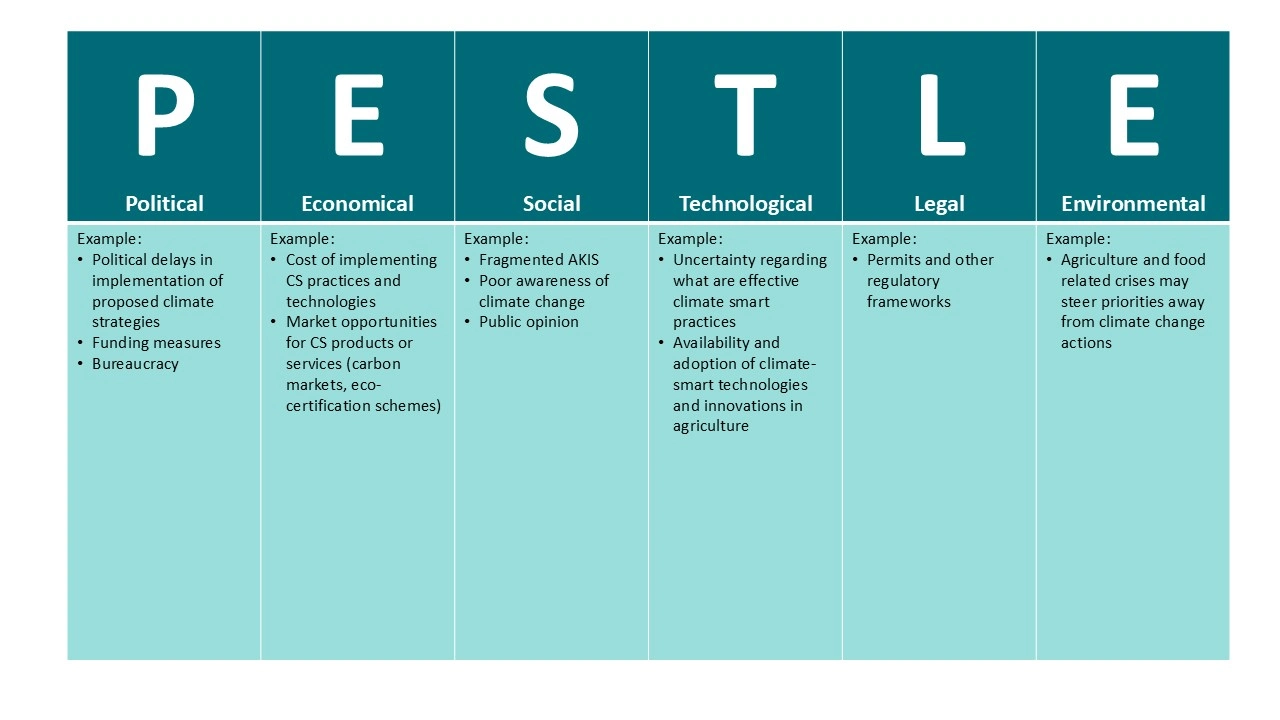
Given the complexity of these external factors, the Political, Economic, Social, Technological, Legal and Environmental (PESTLE) framework is a helpful tool for structuring the analysis. PESTLE focuses on identifying key external elements – political, economic, social, technological, legal and environmental – over which there is little control, but which may significantly impact CS practices. To apply the PESTLE analysis, create a matrix with each PESTLE category as a column and systematically list the relevant factors, barriers, and opportunities under each heading. This visual overview helps teams discuss, prioritise, and address the most important external influences on climate-smart advising and farming.

Careful analysis enables proactive action to avoid potential pitfalls and seize new opportunities. By conducting a PESTLE analysis, elements are identified that provide a clearer view of the factors affecting CS practices. Knowing them helps to identify and select the conditions and stakeholders needed to embed climate practices in CS-AKIS.

Native language

Het betrekken van sleutelactoren binnen het nationale Klimaatslim Agrarische Kennis- en Innovatiesysteem (CS-AKIS) —zoals boeren, adviseurs, onderzoekers, beleidsmakers, technologieaanbieders en het brede publiek—is essentieel voor effectief klimaatslim advies en klimaatslimme landbouw. Het CSA-project ontwikkelde daarom een 6-stappenplan voor Nationale Coördinatoren en Klimaatslimme Coaches om CS-AKIS-actoren te activeren en te engageren.

Voordat actoren worden geïdentificeerd, is een grondige analyse -door de CSA partners en CoP leden- van het huidige landschap rond klimaatmitigatie en -adaptatie in de landbouw nodig. Dit omvat het signaleren van kansen voor klimaatslimme praktijken en het aanpakken van barrières zoals beleidsbeperkingen, financiële beperkingen en kennishiaten. Welke externe factoren moeten worden meegenomen? Welke factoren beïnvloeden het stimulerende klimaat?

Gezien de complexiteit van deze externe factoren is het Politiek, Economisch, Sociaal, Technologisch, Legaal en Ecologisch (PESTLE) raamwerk een handige tool om de analyse te structureren. PESTLE richt zich op het identificeren van externe elementen—politiek, economisch, sociaal, technologisch, legaal en ecologisch—waar vaak weinig controle over is, maar die een grote invloed kunnen hebben op klimaatslimme praktijken. Je maakt een matrix met elke PESTLE-categorie als kolom en je lijst systematisch de relevante factoren, barrières en kansen onder elke hoofding op. Dit visuele overzicht helpt om de belangrijkste externe invloeden op klimaatslim advies en landbouw te bespreken, prioriteren en aanpakken.

Een zorgvuldige analyse maakt proactief handelen mogelijk om valkuilen te vermijden en nieuwe kansen te benutten. Door een PESTLE-analyse uit te voeren, worden elementen geïdentificeerd die een duidelijker beeld geven van de factoren die klimaatslimme praktijken beïnvloeden. Deze kennis helpt om de voorwaarden en CS-AKIS actoren te bepalen die nodig zijn om klimaatacties in CS-AKIS te verankeren.