

Virtual Fences as a Way of Efficient, Climate Adapted and Environmentally Friendly Grazing

Author/s:

Benefits of the Practice

Protection of sensitive ecosystems and biodiversity
Climate protection through improved grazing management
Efficient use of resources and adaptation to climate change

Thematic Areas

Grassland ManagementHerd Management
English language

Summary for Practitioners on the Main Finding/s or Innovative Solution/s

Within the framework of the ClimateSmartAdvisors (CSA) project and its activities within Communities of Practice, virtual fencing was identified and discussed as an innovative technology with strong potential for climate-smart livestock management.

Virtual fencing is an innovative technology for managing grazing livestock without physical fencing infrastructure. Using GPS collars or ear tags, virtual grazing boundaries are defined that guide animals through acoustic signals and mild impulses.

Virtual fences allow the flexible exclusion of ecologically sensitive areas such as wetlands, riparian zones, or erosion-prone soils. This reduces trampling damage, nutrient runoff into water bodies, and soil erosion.

More precise grazing management promotes uniform grazing and healthy swards. This enhances soil carbon sequestration, improves water retention capacity, and reduces areas affected by overgrazing or undergrazing.

From a climate perspective, virtual fencing contributes primarily to adaptation. It enables rapid adjustment of grazing areas in response to weather extremes such as droughts or heavy rainfall, without requiring structural interventions. This increases farm resilience to climate risks while improving labour efficiency and supporting animal welfare through better-managed grazing conditions.

The CSA thematic exchange event highlighted that scaling digital innovations such as virtual fencing from pilot projects to wider practice requires continued advisory support, farmer training, and cross-regional knowledge sharing within Communities of Practice. Virtual fencing was recognised as a promising tool to strengthen the sustainability, flexibility, and climate resilience of grassland-based livestock systems.

Native language


Im Rahmen des ClimateSmartAdvisors (CSA)-Projekts wurde Virtual Fencing als innovative Technologie mit großem Potenzial für ein klimaangepasstes Herden- und Weidemanagement identifiziert und diskutiert. Das Thema wurde in einer thematischen Online-Veranstaltung gemeinsam von den Themenbereichen Herd Management (CFD) und Grassland Management (CSA) unter dem Titel „Virtual Fencing – from pilot to practice?“ aufgegriffen. Das Webinar ermöglichte den Wissensaustausch zwischen Beratenden, Forschenden und Praktikerinnen und Praktikern zur Überführung von Pilotanwendungen in die landwirtschaftliche Praxis.

Virtual Fencing ist eine innovative Technologie zur Steuerung von Weidetieren ohne physische Zauninfrastruktur. Mithilfe von GPS-Halsbändern oder Ohrmarken werden virtuelle Weidegrenzen definiert, die Tiere durch akustische Signale und leichte Impulse leiten.

Virtuelle Zäune ermöglichen den flexiblen Ausschluss ökologisch sensibler Bereiche wie Feuchtgebiete, Uferzonen oder erosionsgefährdete Böden. Dadurch werden Trittschäden, Nährstoffeinträge in Gewässer sowie Bodenerosion reduziert. Ein präziseres Weidemanagement fördert eine gleichmäßige Beweidung und gesunde Grasnarben. Dies verbessert die Kohlenstoffspeicherung im Boden, erhöht die Wasserspeicherfähigkeit und reduziert Flächen mit Über- oder Unterbeweidung.

Aus klimapolitischer Sicht leistet Virtual Fencing vor allem einen Beitrag zur Anpassung an den Klimawandel. Weideflächen können kurzfristig und ohne bauliche Eingriffe an Wetterextreme, wie Dürre oder Starkniederschläge angepasst werden. Dies erhöht die Resilienz landwirtschaftlicher Betriebe gegenüber Klimarisiken, verbessert die Arbeitseffizienz und unterstützt das Tierwohl durch optimierte Weideführung.

Der Austausch im Thematic-Network-Webinar verdeutlichte, dass für den Übergang von Pilotprojekten in eine breitere praktische Anwendung weiterhin Beratungsangebote, Schulungen für Landwirtinnen und Landwirte sowie ein kontinuierlicher Wissenstransfer innerhalb von Communities of Practice erforderlich sind.

Fazit
Virtual Fencing stellt einen vielversprechenden Ansatz dar, um Weidesysteme nachhaltiger, flexibler und klimaresilienter zu gestalten.

Additional Information

1. Regulatory status: No EU-wide harmonised approval yet; use depends on national animal welfare regulations
2. Costs: Investment in GPS collars/tags plus ongoing software and data fees; savings from reduced physical fencing
3. Effort: Initial setup and animal training required; day-to-day management mainly digital and time-efficient
4. Practical limits: Reliable GPS and power supply needed; best suited for extensive grazing systems
5. Experiences from initial pilot projects and practical applications presented and discussed within the CSA knowledge exchange demonstrate significant potential for enabling more efficient, climate- and environmentally friendly grazing systems.
6. At the same time, species-rich grasslands can be specifically protected or grazed for limited periods, supporting biodiversity objectives.
7. In addition, the need for materials, transport, and maintenance associated with conventional fencing is eliminated, lowering resource use and reducing indirect greenhouse gas emissions.

Virtual fencing – technology overview and applications (Wikipedia)

Virtual fencing in grassland-based livestock systems – practical overview

Virtual Fencing Technology for Cattle Management – Review paper (MDPI, 2023)

Effectiveness and animal welfare aspects of virtual fencing (Animal / Thünen Institute)
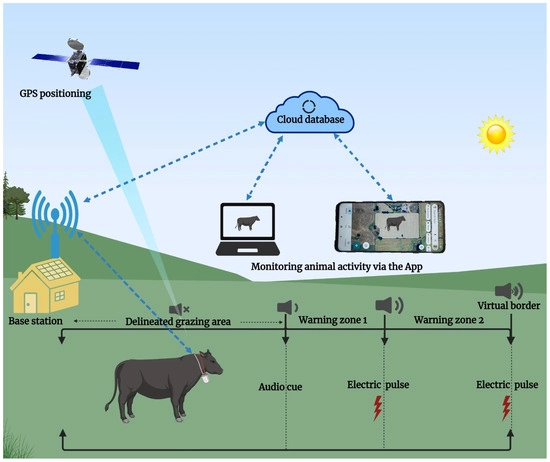
Detailed schematic representation of the virtual fencing concept, including the components used. GPS—Global Positioning System. In: Influence of Virtual Fencing Technology in Cattle Management and Animal Welfare