Which Climate Smart Farming Tools do Advisors Know and Use?

Author/s:

Benefits of the Practice

Carbon tools
Climate smart farming advice
CSF tools
English language

Summary for Practitioners on the Main Finding/s or Innovative Solution/s

As part of the Climate Smart Advisors (CSA) project, advisors from 10 European countries were interviewed in national focus groups. One of the objectives of this study was to ascertain their level of knowledge and use of advisory tools for climate-smart agriculture. This summary outlines the main findings of this work.

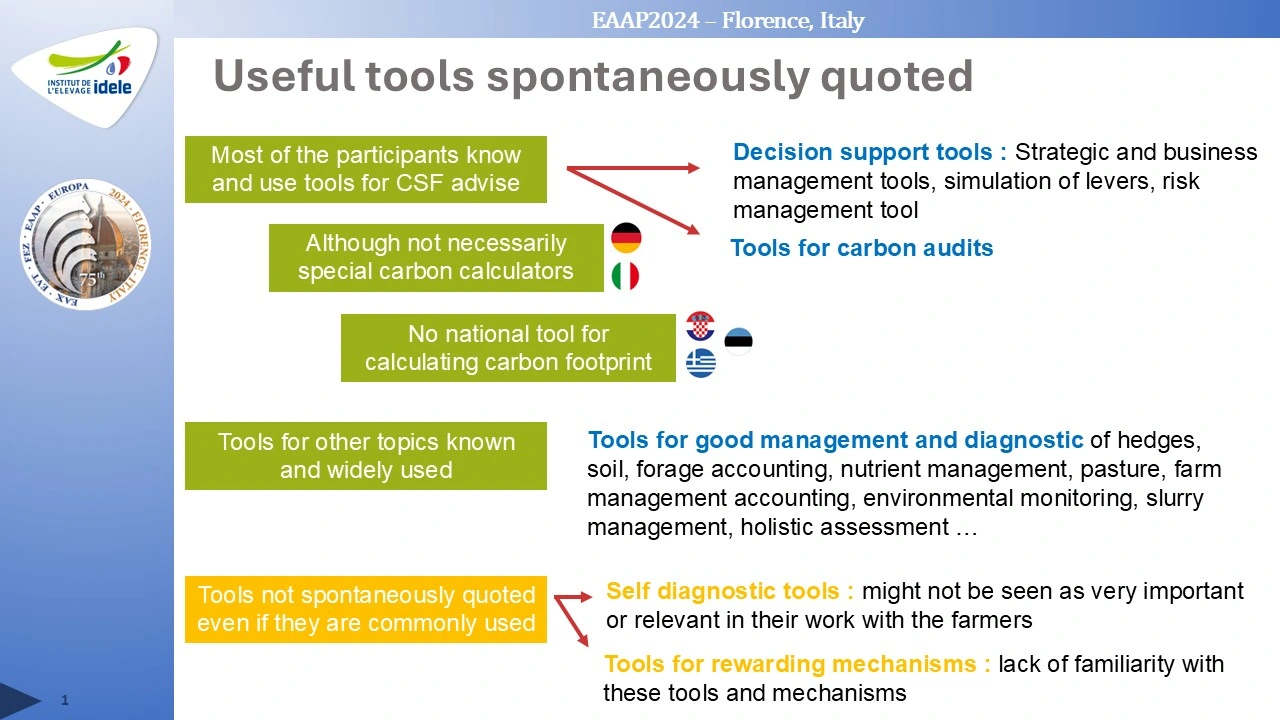
In most of the countries concerned (France, Ireland, Denmark, Spain, Germany and Italy), advisors indicated that they regularly use a wide range of tools. The tools mentioned by the focus groups, while not exhaustive, cover a wide range of objectives The most frequently cited tools relate to carbon diagnostics and various decision support tools, covering a diversity of topics, such as agricultural economics, nutrient management, soil health, biodiversity assessment and overall farm diagnostics. The level of use of carbon-specific tools varies between these countries. It is linked to the interest shown by farmers and the agri-food industry in carrying out carbon assessments. Finally, tools enabling carbon certification are not widely available.

Conversely, in Croatia, Estonia and Greece, advisors do not currently have tools available to calculate carbon footprints and therefore advisors have no experience handling these new technologies. However, their participation in the Climate Farm Demo project should facilitate the introduction and gradual use of specific tools such as CAP2ER or Agrecalc for example.

Initiated by the CSA project (in collaboration with the Climate Farm Demo and ClieNfarms projects), there is now a reference platform, Farming for Climate, which centralizes all the tools available for advice on CCS, both for adaptation and mitigation tools. The aim is to enable each advisor to find the most relevant tool that meets their needs, at the expected level of specialization, and tailored to their sector.

Native language

Dans le cadre du projet Climate Smart Advisors (CSA), des conseillers issus de 10 pays européens ont été interrogés au sein de groupes de discussion. L’un des objectifs de cette étude était d’évaluer leur niveau de connaissance et leur utilisation des outils de conseil en matière d’agriculture intelligente face au climat.

Dans la plupart des pays (France, Irlande, Danemark, Espagne, Allemagne et Italie), les conseillers ont indiqué qu’ils utilisaient régulièrement un large éventail d’outils. Les outils mentionnés, bien que non exhaustifs, couvrent un large éventail d’objectifs. Les outils les plus cités concernent les diagnostics carbone et divers outils d’aide à la décision, couvrant une diversité de sujets: l’économie agricole, la gestion des nutriments, la santé des sols, l’évaluation de la biodiversité et les diagnostics globaux des exploitations agricoles. Le niveau d’utilisation des outils spécifiques au carbone varie entre ces pays. Il est lié à l’intérêt des agriculteurs et de l’industrie agroalimentaire pour la réalisation de bilans carbone. Enfin, les outils permettant la certification carbone sont peu répandus.

À l’inverse, en Croatie, Estonie et Grèce, les conseillers ne disposent actuellement d’aucun outil pour calculer l’empreinte carbone et sont peu expérimentés sur l’utilisation de ces nouvelles technologies. Leur participation au projet Climate Farm Demo devrait faciliter l’utilisation progressive d’outils spécifiques tels que CAP2ER ou Agrecalc.

À l’initiative du projet CSA (en lien avec les projets CFD et Clienfarms) a été créé une plateforme de référence (Farming for Climate) qui centralise tous les outils disponibles pour le conseil en matière de climat, tant pour les outils d’adaptation que d’atténuation. L’objectif est de que chaque conseiller trouve l’outil le plus pertinent qui réponde à ses besoins, au niveau de spécialisation attendu et adapté à son secteur.

Additional Information